
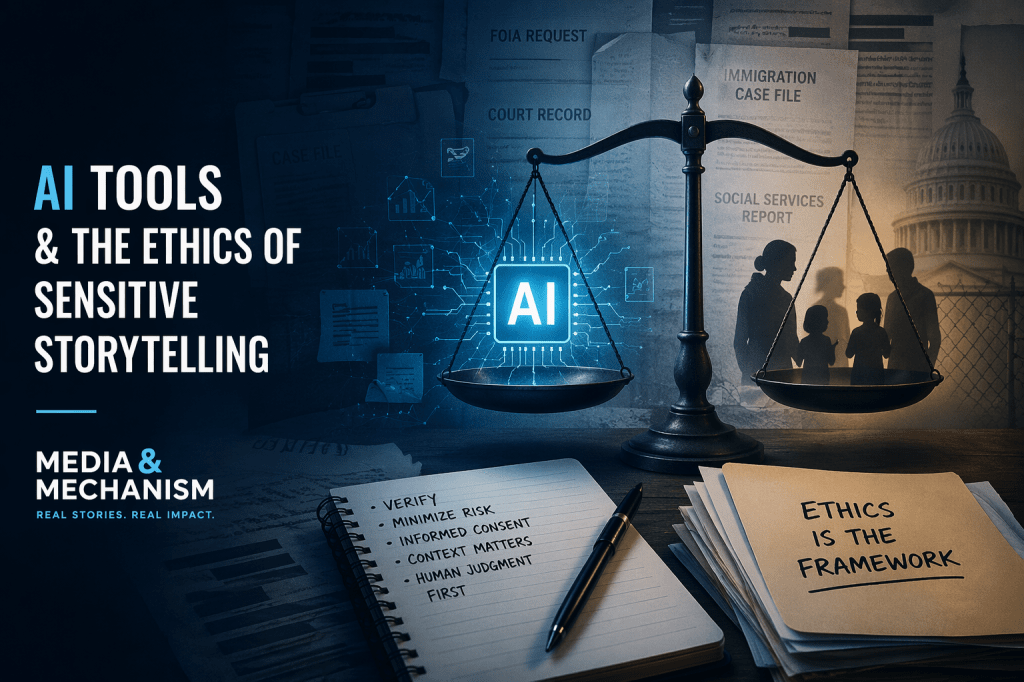
The same capabilities that make AI useful for investigative research — pattern recognition, document synthesis, source mapping — create real risks when the subjects are vulnerable people. Here’s how to think about the line.
By Mike Phillips
There’s a version of this conversation that goes: AI is either a miracle or a catastrophe, and whichever side you’re on, you’re right. That conversation is not very useful. The more productive question — the one journalists, nonprofit communicators, and advocacy researchers are actually working through right now — is narrower and more specific: which tasks does AI-assisted research genuinely improve, and which tasks does it quietly make more dangerous?
The answer depends almost entirely on who the subjects are. For investigative work involving institutions — federal agencies, corporate defendants, court systems — AI research tools are straightforwardly powerful, and the risk profile is manageable. For work involving vulnerable people — undocumented immigrants, trafficking survivors, children in legal proceedings, people with mental health histories — the calculus is different in ways that most practitioners haven’t fully worked out yet.
This piece is an attempt to work it out.
Where AI-Assisted Research Actually Helps
Start with the honest case for these tools, because it’s real.
Document analysis at scale is the clearest win. Investigative journalists and nonprofit researchers regularly work with document sets that are simply too large to read comprehensively by hand — FOIA productions running thousands of pages, PACER filings across multi-jurisdiction cases, legislative hearing transcripts, and state budget documents. Tools like Google Pinpoint and NotebookLM allow a researcher to surface patterns, identify contradictions, and locate relevant passages across large corpora in a fraction of the time manual review would require. The researcher still reads the documents. The AI is doing the index and the first-pass filter, not the analysis.
Pattern recognition across cases is similarly valuable. When you’re trying to establish that something is systemic — that a court, an agency, or a policy is producing consistent harm across a population rather than isolated incidents — you need to aggregate cases. AI-assisted tools can help identify structural similarities across filings, flag recurring language in judicial orders, or map the geographic and demographic patterns in a dataset of outcomes. That kind of analysis used to require either a large team or a data journalism partner. It’s now accessible to a solo reporter or a small nonprofit communications shop.
Source mapping and background research are also genuinely accelerated. Understanding the organizational structure of a federal agency, the legislative history of a statute, or the prior professional record of an official involved in a story — all of that foundational research moves faster with AI assistance. Getting to the substantive questions more quickly means more time for the work that AI can’t do: cultivating sources, conducting interviews, exercising editorial judgment.
Where the Risks Are Real
None of that changes when the subject shifts from institutions to people. What changes is what’s at stake when something goes wrong.
The aggregation problem.
AI tools are good at connecting dots. That’s the point. But in work involving vulnerable populations, connecting dots can constitute harm. An undocumented individual whose name, employer, neighborhood, and family structure appear across multiple documents in a research corpus doesn’t become safer when those dots are easier to connect — they become more exposed. The same capability that helps a researcher identify systemic patterns can, applied carelessly, produce a detailed profile of a specific person that creates real-world risk. The researcher needs to be thinking about this actively, not after the fact.
Inference and hallucination in sensitive contexts.
Large language models generate plausible text. They do not verify facts. In most research contexts, a confident-sounding error is annoying and correctable. In work involving a trafficking survivor’s case history, a child’s legal status, or a subject’s mental health record, a confident-sounding error that makes it into a published story or an organizational communication isn’t just a correction — it can damage a person’s legal case, their safety, or their relationship with the organization that was supposed to be helping them. The standard of verification for AI-assisted research involving vulnerable people needs to be higher than for institutional research, not the same.
Consent and the invisible data trail.
When a researcher uploads documents to an AI platform — a case file, a client intake form, a set of interview notes — those documents are in a system. The privacy policies governing what happens to that data vary enormously across platforms, change without prominent notice, and are rarely read carefully by practitioners under deadline pressure. A client who consented to their story being told did not necessarily consent to their intake documents being processed by a third-party AI platform. That’s a meaningful distinction that the field hasn’t caught up to yet.
The efficiency trap.
This one is subtler. AI tools make certain parts of research faster, which creates pressure — implicit or explicit — to move faster overall. In work involving vulnerable subjects, speed is often the enemy of care. The part of the process that should not be accelerated is the human part: the relationship with the source, the iterative consent conversation, the editorial judgment about what serves the subject’s interests versus the story’s. When AI-assisted efficiency in the research phase generates organizational expectations that the whole process should move at that pace, the parts that require slowness get squeezed.
A Practical Framework
None of this argues for avoiding AI tools in sensitive storytelling work. It argues for using them with a clear-eyed understanding of where the leverage is and where the exposure is.
A few principles that hold up in practice:
Use AI on institutional documents, not on personal ones.
Court records, agency filings, legislative documents, corporate disclosures — these are appropriate inputs for AI-assisted analysis. Client intake files, interview transcripts, personal communications, and case notes are not. The distinction is between documents about systems and documents about people.
Treat AI output as a lead, not a finding.
Everything an AI tool surfaces needs to be verified through primary sources before it informs a published story or organizational communication. This is basic research hygiene, but it’s especially non-negotiable when a factual error could harm a person.
Have a data handling policy and actually follow it.
What documents go into which platforms, under what terms, with what data retention practices — these are decisions that should be made deliberately at the organizational level, not left to individual researchers in the moment. If your organization works with vulnerable populations and doesn’t have a written AI data handling policy, that’s a gap worth closing before the next project starts.
Slow down at the human juncture.
AI can accelerate the desk research. It cannot accelerate the trust-building, the consent conversation, or the editorial judgment. Those parts should take as long as they take.
The organizations doing this well aren’t the ones that have banned AI tools or the ones that have adopted them without thinking. They’re the ones that have been precise about what the tools are actually for — and clear-eyed about what they’re not for. That precision is what responsible practice looks like, and in work involving vulnerable people, responsible practice isn’t a nice-to-have. It’s the whole job.
Mike Phillips is a freelance investigative journalist and communications consultant. He covers technology, media, and institutional accountability at Media & Mechanism.


Leave a comment