
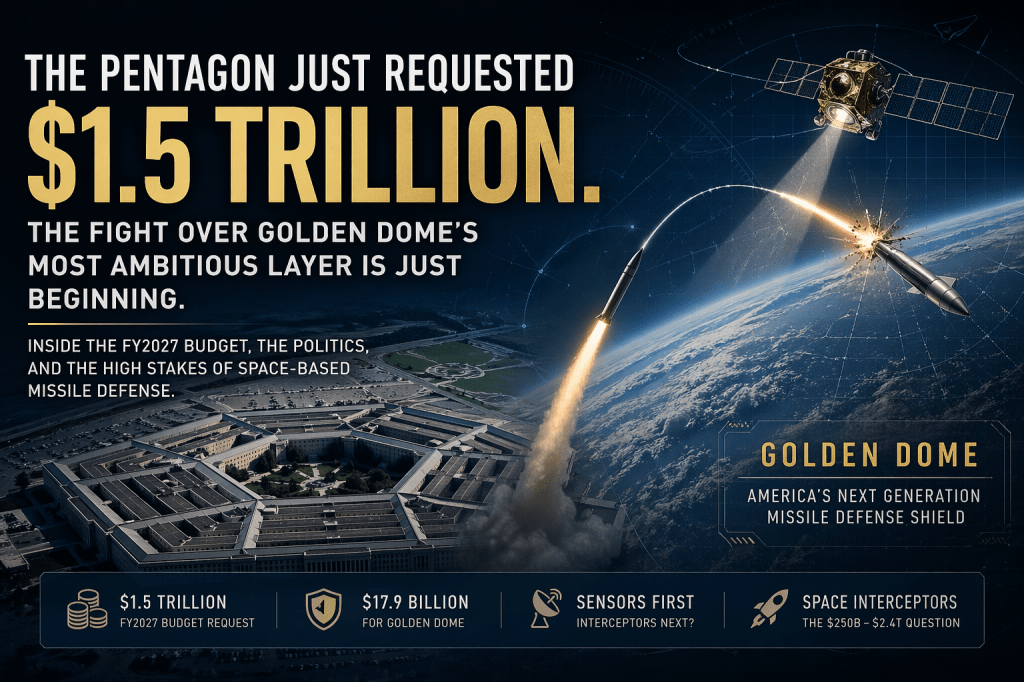
The FY2027 budget drops a landmark number. Whether space-based interceptors survive the program’s cost reckoning is a different question entirely.
By Michael Phillips
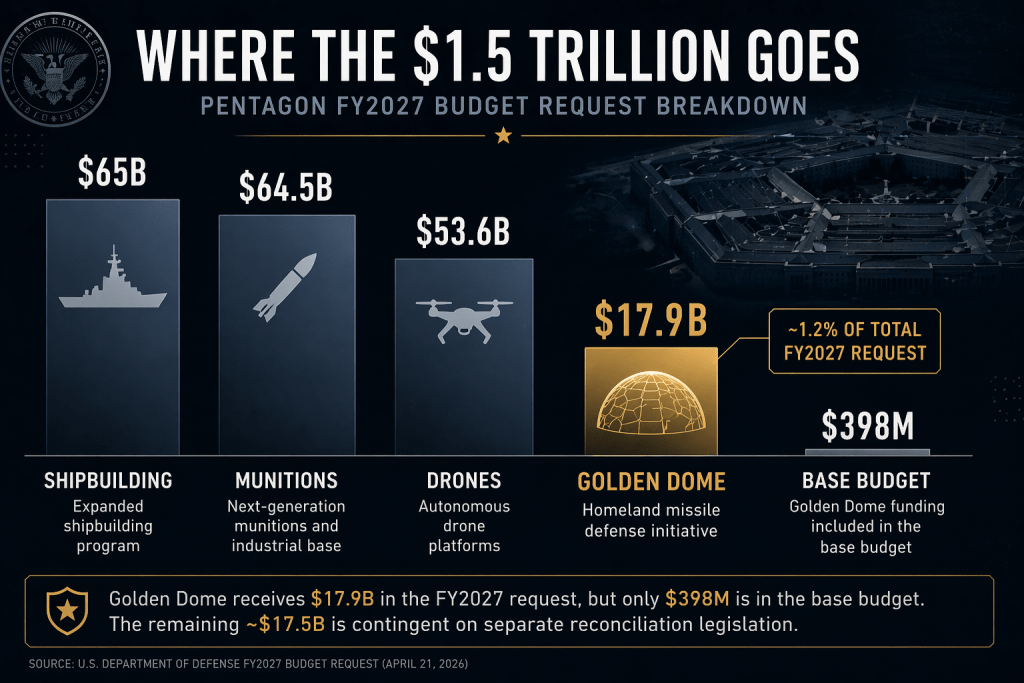
On April 21, the Pentagon unveiled the largest defense budget request in American history: $1.5 trillion for fiscal year 2027, a 42 percent year-over-year increase that Pentagon comptroller Jules Hurst described as “a generational investment in the United States military.” The headline numbers are staggering — $53.6 billion for autonomous drone platforms, $65 billion for an expanded shipbuilding program, $64.5 billion for next-generation munitions. But buried inside the request, and already sparking the sharpest debate among defense analysts and lawmakers, is the line that matters most for the future of American space power: $17.5 billion for Golden Dome.
More precisely, what matters isn’t the number. It’s the question of whether the program’s most ambitious component — space-based interceptors capable of killing ballistic and hypersonic missiles during their boost phase, before they ever leave the atmosphere — will survive the program’s growing cost reckoning.
What Golden Dome Actually Is
Golden Dome is the Trump administration’s signature homeland missile defense initiative, launched by executive order in the first week of the president’s second term. The concept is a layered, multi-domain defensive shield — sensors on the ground, in low Earth orbit, and in medium Earth orbit; command-and-control infrastructure linking them; and, most controversially, interceptors operating from space itself, designed to engage missiles in their most vulnerable window: the boost phase, when they’re still climbing, slow, and hot.

In May 2025, Trump unveiled the program from the Oval Office with a $175 billion price tag and a promise of initial operational capability within three years. Since then, the numbers have moved in one direction only. The Pentagon’s own estimate has grown to $185 billion. The Congressional Budget Office has put it at $542 billion. The American Enterprise Institute’s Todd Harrison has offered a range from $250 billion to $2.4 trillion, depending on how aggressively the space-based interceptor layer is built out.
The wide variance isn’t analysts guessing in the dark. It’s a direct reflection of the fact that the program’s architecture remains largely classified, and the single biggest cost variable — how many space-based interceptors the system will actually require, and at what unit cost — hasn’t been publicly resolved.
The FY2027 Budget and the Space Layer
The FY2027 request allocates approximately $17.9 billion for Golden Dome, down from the $25 billion appropriated in FY2026 through the reconciliation process. Of that $17.9 billion, only $398 million sits in the base budget — the rest is contingent on Congress passing a separate reconciliation package. That’s a significant structural risk that defense analyst Tom Karako of the Center for Strategic and International Studies has described as a deliberate “legislative strategy,” forcing the reconciliation bill to be must-pass by loading it with key defense priorities. The gamble may be sound politics. It’s also a program management exposure.
For the Space Force specifically, FY2027 brings a significant boost to the Resilient Missile Warning and Tracking program — the constellation of satellites in LEO and MEO designed to detect and track ballistic missiles and hypersonic glide vehicles. Funding for that program more than doubled in the request, reflecting the administration’s stated intent to “expand the sensing network” before committing to the intercept layer. That sequencing — sensors before shooters — is standard acquisition logic. It also happens to be the part of the program where the technical risk is lowest, and the path to demonstrated capability is clearest.
The space-based interceptors are another matter.
Guetlein’s Signal
In testimony before the House Armed Services Strategic Forces subcommittee earlier this month, Gen. Michael Guetlein — the Pentagon’s Golden Dome program director — said something that received less attention than it deserved: “If boost-phase intercept from space is not affordable and scalable, we will not produce it because we have other options to get after it.”
If boost-phase intercept from space is not affordable and scalable, we will not produce it because we have other options to get after it.
Gen. Michael Guetlein — the Pentagon’s Golden Dome program director
That’s a significant hedge from the man running the program. Guetlein didn’t close the door on space-based interceptors. But he opened the door to descoping the program’s most politically visible layer if the cost math doesn’t work — and he pointed toward directed energy, artificial intelligence, and advanced data processing as the technologies most likely to drive down the cost-per-kill enough to make space intercept viable at scale.
The Space Force has already awarded prototype contracts to multiple vendors for space-based interceptors through competitive Other Transaction Agreements — the names of the winners are classified, though Northrop Grumman, Lockheed Martin, and startup Apex Space are among the companies publicly known to be working in the space. The FY2027 procurement budget also contains a mysterious $2 billion jump in a line item called “Special Space Activities,” with no public explanation — one credible interpretation is that it functions as a classified holding account for space-based interceptor development funding.
Lockheed Martin has planned a demonstration for 2028. Apex’s “Project Shadow” interceptors are targeting a launch next summer. Northrop has begun ground testing and is providing operational analysis to the Pentagon. The technology is moving. Whether it moves fast enough, and cheaply enough, to survive a genuine cost review is the open question.
The Real Strategic Stakes
This debate isn’t merely about acquisition economics. It sits at the intersection of two strategic realities that are reshaping the entire defense posture.
The first is the pace of adversary capability development. The Space Force’s newly released 15-year Objective Force plan acknowledges that China’s satellite fleet exceeded 1,060 operational spacecraft by mid-2025, with hundreds dedicated to intelligence, surveillance, and reconnaissance. Russia has demonstrated disruptive anti-satellite capabilities. Both nations are investing in counter-space operations — meaning that any space-based architecture the U.S. builds for Golden Dome is also an architecture that adversaries will attempt to hold at risk. Putting interceptors in orbit isn’t just a missile defense decision. It’s a decision about how much the U.S. is willing to militarize the space domain and provoke a counter-space response.
This isn’t about building a shield. It’s about deciding how much defense the U.S. is willing to put into orbit—and what that provokes.
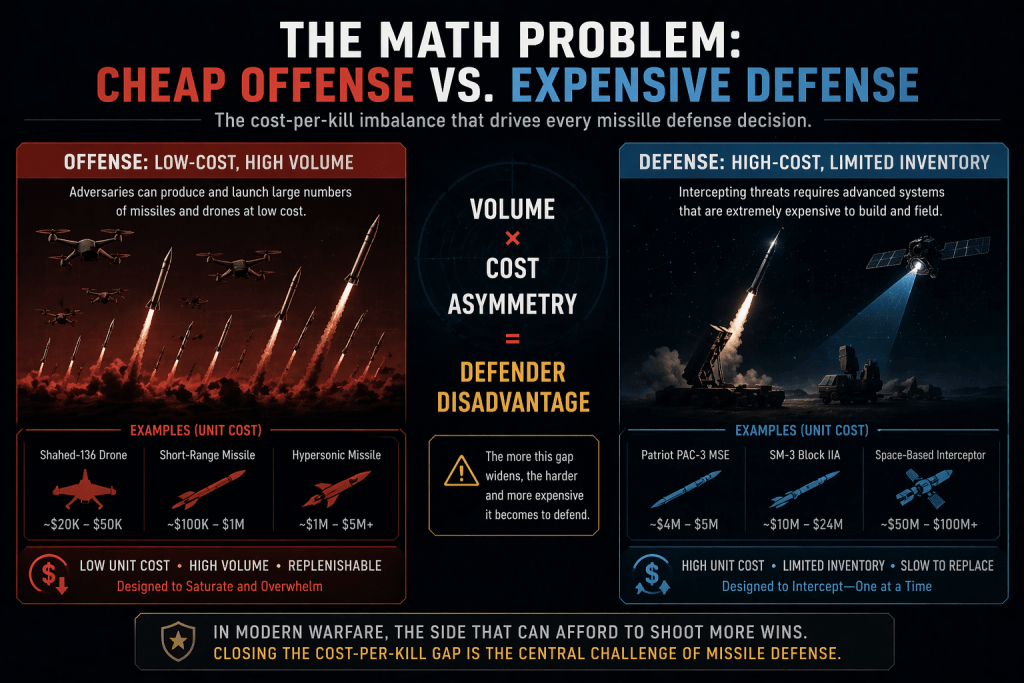
The second is the consumption data coming out of active conflict. The Ukraine war’s air defense arithmetic — hundreds of Shahed drones and cruise missiles against a finite inventory of Patriot, NASAMS, IRIS-T, and electronic warfare assets — has reshaped how Pentagon planners think about the inner tiers of any homeland defense system. Russia’s April 16 strike, which launched 659 drones and 44 missiles in a roughly 24-hour campaign, illustrated the core problem: even with a high intercept rate, the math of high-volume, low-cost offense against expensive high-end interceptors eventually favors the attacker. It’s the same logic driving the $53.6 billion drone request in the FY2027 budget and the emphasis on directed energy as a cost-per-kill solution.
Space-based interceptors don’t solve the volume problem. They address a different threat — the boost phase of ballistic and hypersonic missiles, the window when the target is slowest, most trackable, and most vulnerable. Whether that layer is worth the cost, and whether the technology can be delivered at a scale and price that justifies it, is a question the program will have to answer under conditions of real political and budgetary pressure.
What to Watch
The FY2027 request is a proposal, not a budget. Congressional debate begins now, and the reconciliation package — where most of Golden Dome’s funding actually lives — faces its own political headwinds. A coalition of 289 organizations has already written to Congress opposing the overall request.
For the space layer specifically, watch for three things. First, whether the classified architecture decisions made over the next several months publicly narrow or expand the interceptor ambition. Second, whether the “Special Space Activities” line item gets any congressional scrutiny that forces transparency about what’s actually being funded. And third, whether any of the prototype vendors — Apex, Lockheed, or others not yet named — demonstrate hardware performance in 2026 that changes the cost calculus Guetlein laid out in his testimony.
The $1.5 trillion headline is real. But the fight over whether America will actually field a weapon system capable of shooting down missiles from space — and what that would mean for stability in the space domain — is just getting started.
The $1.5 trillion headline is real. The question is whether the most ambitious part of it ever gets built.
 Mike Phillips Tech
Leave a comment